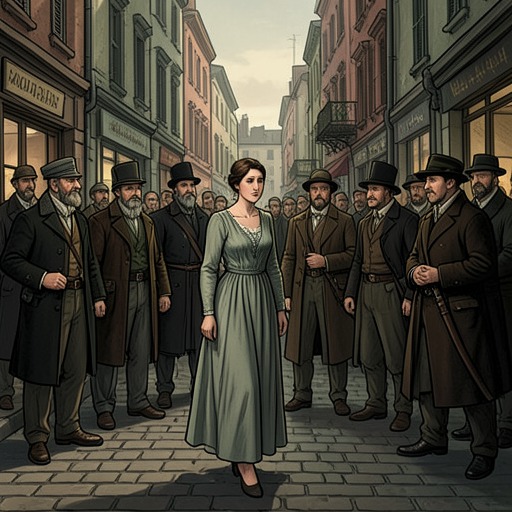
Buddy Willard
The Bell JarBuddy Willard’s importance in Esther Greenwood’s story lies in the collapse of an ideal: the young man she once adored becomes, in her eyes, a hypocrite whose sexual conduct and expectations of marriage reveal the gendered bargain she refuses. His continuing presence—first as suitor, later as a visitor at Belsize—also measures how far Esther’s judgment and self-determination have moved from the years when she imagined marrying him.
Identity and Early Idealization
For five years, Esther adored Buddy from a distance before he began to notice her. As his attention grew, she believed him wonderful and took his manner of presenting himself as innocent at face value. The account later revises that early image: Buddy had made Esther feel more sexually experienced than he was, implying that his own embraces, kisses, and petting arose involuntarily from her influence. The imbalance was not simply a difference in experience; his pose encouraged her to understand his desire as something she had caused, while he appeared untouched by it.
Esther’s later verdict is blunt: Buddy is a hypocrite. She does not arrive at that judgment through abstract suspicion. She says she discovered his duplicity by accident, and the recollection ties the rupture to the period when she visited him after his medical-school scholarship came through. Instead of going to Yale, she went to see him; there, on the day she witnessed a baby being born, she learned what his pious-seeming sexual innocence had concealed. The revelation turns a long-held romantic ideal into a source of anger and distrust.
Courtship, Disclosure, and Refusal
Buddy’s confession that he had slept with someone else overturns the account he had encouraged Esther to believe. Hearing him acknowledge, “Well, yes, I have,” she is nearly knocked off balance. The disclosure makes visible the double standard embedded in his earlier performance: Esther had been made to feel worldly and culpable for the couple’s physical intimacy, while Buddy’s own sexual history had remained hidden behind an appearance of innocence. Once that appearance breaks, she no longer regards his behavior as proof of her power over him; she sees it as evidence that he had been pretending.
Even after she has lost faith in him, Esther cannot immediately tell Buddy the unvarnished truth. He contracts tuberculosis before she can confront him, and she feels obliged to humor him until he recovers. His illness therefore complicates the break: her contempt and anger coexist with a restraint imposed by his vulnerable condition. She can privately know she will never marry him, yet still feel unable to say so in the direct terms she believes he deserves.
Buddy eventually asks Esther to become his wife. He sits beside her, puts an arm around her waist, brushes the hair from her ear, and whispers, “How would you like to be Mrs. Buddy Willard?” Esther’s first response is an impulse to laugh. The proposal would once have overwhelmed her during the years of distant adoration; now it meets a settled refusal. When Buddy says she will change her mind, she answers, “I'm never going to get married,” then confirms that her mind is made up. The exchange marks more than the end of a courtship: Esther rejects the future that Buddy’s name and proposal offer as a prescribed role rather than a destiny she wants.
Marriage and the Domestic Future
Esther’s resistance is sharpened by what she imagines marriage demands of a woman. After sleeping beside Constantin, she pictures a married life of rising at seven to cook eggs, bacon, toast, and coffee; washing plates and making the bed after her husband leaves; preparing dinner when he returns; and ending the evening over more dishes, exhausted. The fantasy is not presented as a particular life Buddy has already imposed on her, but as the domestic pattern she fears his proposal would carry with it.
That fear draws force from the example of Mrs. Willard, Buddy’s mother. Esther remembers her braiding a rug from strips of Mr. Willard’s old suits, a laborious object Esther admired for its tweedy pattern. Mrs. Willard put it on the kitchen floor, where it soon became soiled and indistinguishable from a cheap mat. Esther reads that transformation as an image of a woman’s creative effort reduced to household use. She connects it to Buddy’s suggestion that having children would make her stop wanting to write poems, and to her own mother’s account of her father declaring, after their honeymoon, that they could stop pretending and be themselves. In Esther’s view, the romantic attentions before marriage can give way to a demand that a wife flatten herself into domestic service.
Her professional anxieties belong to the same conflict. Esther does not know shorthand, a skill her widowed mother has taught and urged her to learn so she can support herself. Her mother warns that a plain English major will not be in demand, whereas an English major who can take shorthand could secure work transcribing letters for ambitious young men. Esther hates the idea of serving men in that way: she wants to dictate her own letters. Against that contrast between her mother’s practical advice and her own wish for authorship, Buddy’s imagined wifehood represents another future in which her abilities and desires might be subordinated to a man’s needs.
The Willard Family and Esther’s Other Relationships
Esther’s connection to the Willards extends beyond Buddy. Joan Gilling tells Esther that she loved Mr. and Mrs. Willard because they were kind and happy, unlike her own parents, and that she visited them often until Esther entered the picture. The confession gives the family a significance in Joan’s history as well as Esther’s: the Willards were a place of attachment for Joan, and Esther’s presence altered that pattern. It does not erase Esther’s hostility toward the domestic model Mrs. Willard represents, but it shows that the same household could be experienced by another young woman as welcoming and secure.
By the time Buddy visits Esther at Belsize, their old courtship has become a relationship viewed from a distance. Buddy enters with his khaki cap in hand. His manner is no longer the easy certainty Esther once associated with him: she sees a grave, tentative face, belonging to a man who often does not get what he wants. He asks whether something in him drives women crazy. Esther replies that he had nothing to do with what happened between them. Her reassurance distinguishes his past relationship with her from Joan’s suicide; she refuses to make him responsible for Joan’s death, even as the question exposes his unease about his effect on women.
Narrative Role and Significance
Buddy’s arc is narrated through Esther’s changing recollections and later judgments. His early courtship is not an independent portrait of his inner life so much as a test of Esther’s interpretation: she first takes him for an ideal, then re-reads his sexual conduct as hypocrisy, and finally encounters him as a diminished, uncertain figure. The shifts make her account of him inseparable from her own developing resistance to conventional expectations.
His proposal brings that conflict into a concrete scene, while the domestic examples around him give Esther’s refusal its social meaning. Marriage appears not as a neutral romantic choice but as a possible transfer of labor and authority—from a woman’s education, writing, and self-direction to cooking, cleaning, and serving a husband. Buddy does not have to enact every feared consequence for his role in the story to matter: as Esther understands him, he embodies the gap between the innocent image he cultivated and the unequal future she believes marriage would require. Her final reassurance at Belsize shows a further change: she can address him without returning to adoration or assigning him blame for Joan, meeting him instead with a clear, bounded judgment.